Indian Regulation Hub
What Is BRSR, and Does My Company Need to File It?
BRSR is India's mandatory ESG report for large listed companies. Here's exactly who has to file it, and what it means if you don't.
TL;DR
BRSR (Business Responsibility and Sustainability Report) is a mandatory annual ESG disclosure required by SEBI (India's securities regulator) for the top 1,000 listed companies by market capitalisation. If your company isn't in that group, you don't have to file it — but if you sell to a company that does, they may still ask you for some of the same data.
Who this is for
Anyone trying to answer, in five minutes, "does BRSR actually apply to my company?"
Plain explanation
BRSR is a standard report, filed alongside a company's annual report, that discloses how it performs on environmental, social, and governance (ESG) matters. It's not optional for the companies it applies to — it's a SEBI filing requirement, similar in spirit to financial disclosures, but for sustainability and business-conduct data instead of revenue and profit.
The report has three sections:
- Section A — General disclosures: basic company profile and operations.
- Section B — Management & process disclosures: policies and governance structures.
- Section C — Principle-wise performance: the actual E, S, and G data, organized around the 9 principles of the NGRBC (National Guidelines on Responsible Business Conduct, issued by the Ministry of Corporate Affairs in 2019).
In total, BRSR asks around 140 questions: about 98 are "Essential Indicators" (mandatory for every company in scope) and about 42 are "Leadership Indicators" (voluntary, for companies that want to disclose more).
India specifics
Who must file: the top 1,000 listed companies by market capitalisation on Indian stock exchanges. This has been mandatory since FY 2022–23. The report is filed in XBRL format as part of the annual report submitted to SEBI — see our filing timeline guide for exactly when that falls in your year.
BRSR Core — the part that gets independently checked. A smaller set of about 49 KPIs, covering things like greenhouse gas emissions, energy mix, water use, and worker safety, must additionally get third-party assurance. This requirement is being phased in by company size, widening every year:
| Financial year | Companies (by market-cap rank) that need BRSR Core assurance |
|---|---|
| FY 2023–24 | Top 150 |
| FY 2024–25 | Top 250 |
| FY 2025–26 | Top 500 |
| FY 2026–27 | Top 1,000 |
If you're not directly in scope, watch two things anyway:
- Your market-cap rank. Companies move in and out of the top 1,000 as valuations shift — check where you stand each year, not just once.
- Your customers. If a company you supply is in scope, they must disclose data about their value chain too. That's usually voluntary for now, but many large companies push the questionnaire down to suppliers regardless, because it makes their own disclosure stronger.
Worked example
Raghav Textiles Ltd. is listed on the NSE with a market capitalisation that puts it around rank 720 by market cap. Because that's inside the top 1,000, Raghav Textiles must file a full BRSR this year. Its BRSR Core KPIs won't need third-party assurance until FY 2026–27, when the requirement reaches the top 1,000 — so this year, filing the report itself is the priority; assurance readiness can follow next cycle.
Contrast this with Raghav Textiles' largest fabric supplier, an unlisted private company. It has no BRSR filing obligation at all — but because Raghav Textiles needs value-chain data for its own report, it has already emailed the supplier a shortened ESG questionnaire covering emissions and worker safety.
Checklist
- Confirm whether your company is listed on an Indian stock exchange.
- If listed, check your approximate market-capitalisation rank — the BSE and NSE both publish market-cap rankings.
- If you're inside the top 1,000, note which BRSR Core assurance year applies to your rank tier.
- If you're not listed or not in the top 1,000, check whether any major customer is — they may still request data from you informally.
- Re-check your scope yearly; rank and thresholds both move.
What to do next
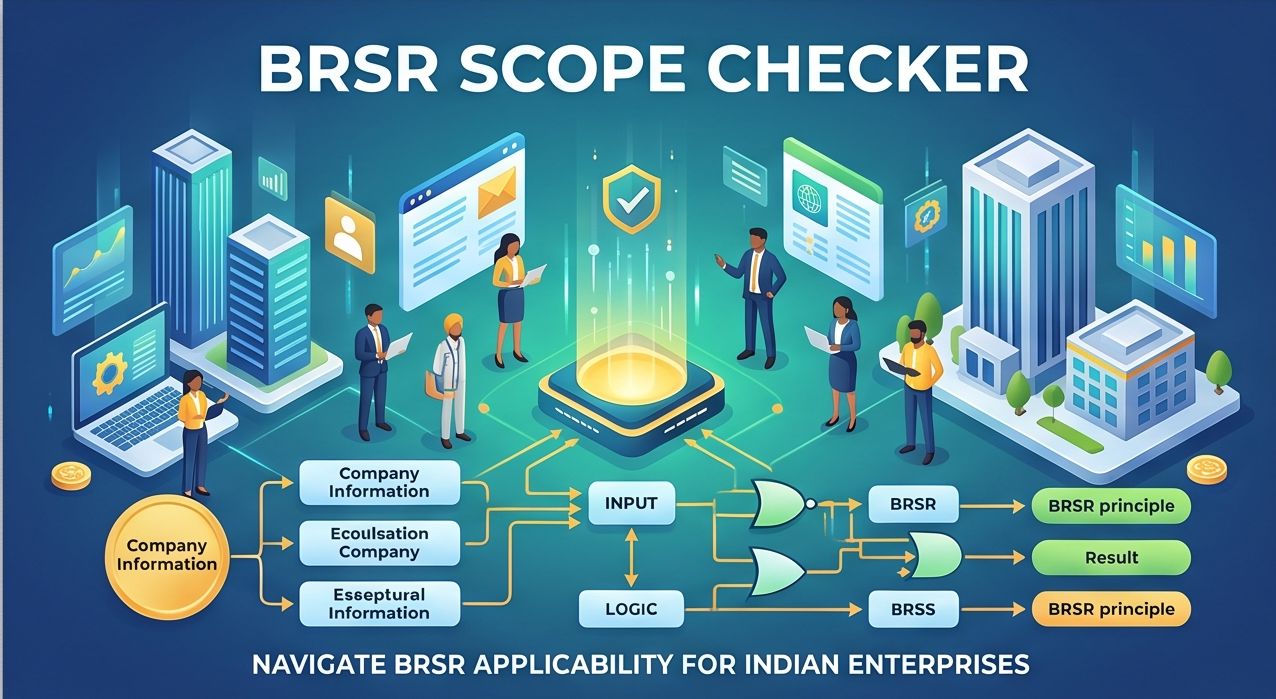
The fastest way to get a definitive answer for your specific company is to run through the checker below.
Current as of: 22 July 2026. BRSR applicability and the BRSR Core assurance glide path are set by SEBI circulars and reviewed here whenever SEBI issues an update — treat any date more than 12 months old as due for a recheck.
Sources: