Indian Regulation Hub
BRSR Core & the 49 KPIs — What Actually Gets Assured
BRSR Core isn't a separate filing — it's a smaller, harder subset of BRSR that gets independently checked. Here's what's actually inside it.
TL;DR
BRSR Core is not a separate report — it's a smaller, harder-edged subset of about 49 Key Performance Indicators (KPIs) pulled from within full BRSR, focused on the metrics investors and regulators consider most measurable and comparable: emissions, energy, water, waste, and a handful of social indicators. These are the numbers that get independent third-party assurance, phased in by company size.
Who this is for
Anyone who's filed (or is about to file) full BRSR and wants to know specifically which of those ~140 questions fall under the tighter, assured BRSR Core subset.
Plain explanation
Full BRSR asks around 140 questions across 9 principles — a mix of narrative answers, policy confirmations, and hard numbers. Regulators recognized that not all of this is equally easy to verify or compare across companies: a policy statement is hard to "audit" in the way a number is. So SEBI carved out a smaller set of quantitative, comparable metrics — the ones most useful to investors trying to compare companies apples-to-apples — and calls that subset BRSR Core.
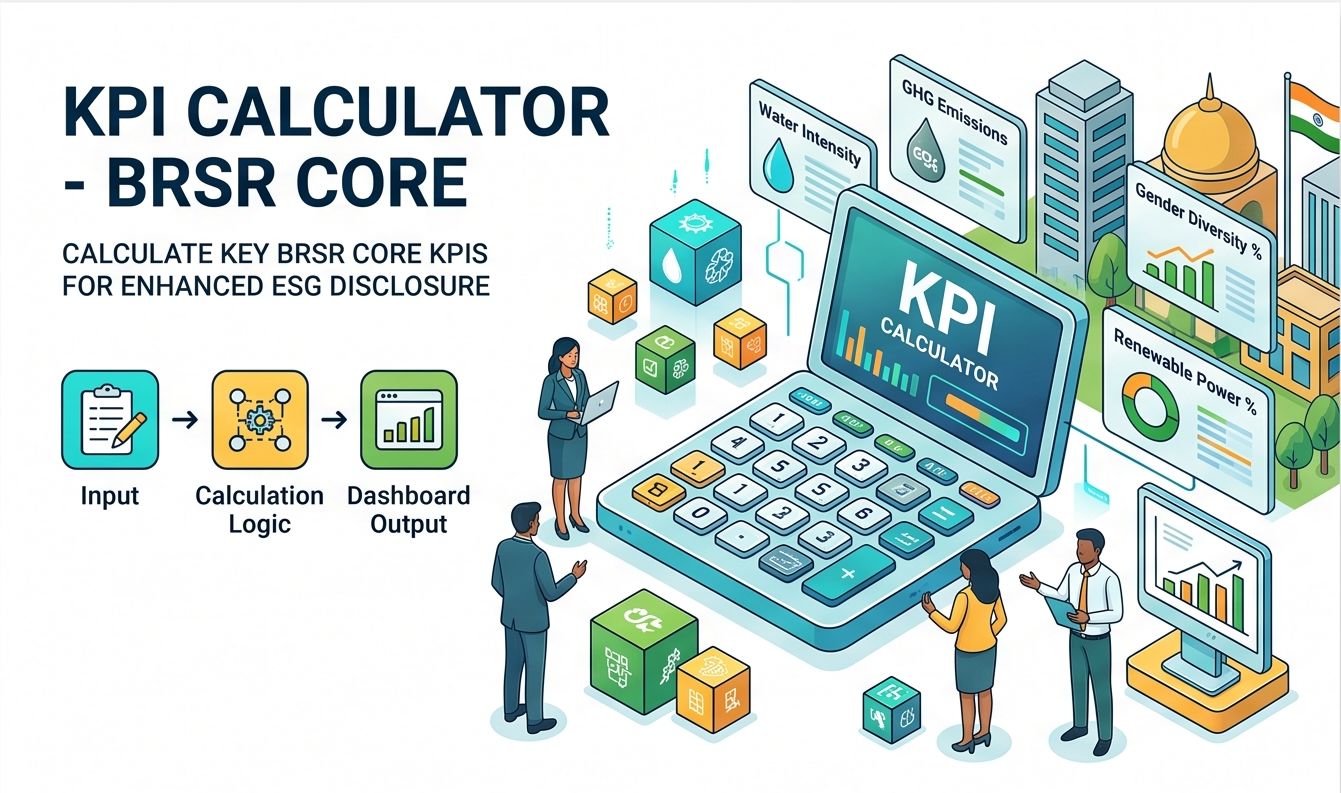
Broadly, BRSR Core's ~49 KPIs cluster around:
- Greenhouse gas emissions — absolute Scope 1 and Scope 2 emissions, and emissions intensity (per unit of revenue or output).
- Energy — total energy consumption and the share coming from renewable sources.
- Water — total water use and discharge, especially relevant for water-intensive industries.
- Waste — waste generated and how much is recycled, reused, or safely disposed of.
- Social indicators — gender diversity (including at leadership level), wages and pay parity, workplace safety incidents (like the frequency of reportable injuries).
These are deliberately the kind of numbers that can be independently checked against source records — unlike a narrative statement about "commitment to ethical sourcing," a claimed emissions figure can be traced back to fuel bills and electricity invoices and verified.
India specifics
BRSR Core KPIs require third-party reasonable assurance, phased in by market-cap rank — the same glide path covered in our assurance vs. assessment guide:
| Financial year | Companies (by market-cap rank) needing BRSR Core assurance |
|---|---|
| FY 2023–24 | Top 150 |
| FY 2024–25 | Top 250 |
| FY 2025–26 | Top 500 |
| FY 2026–27 | Top 1,000 |
If you're filing full BRSR but not yet in the BRSR Core assurance tier, you generally still report the same underlying data — you just aren't required to get it independently assured yet. It's worth treating that data with assurance-level rigor anyway, since your tier will widen eventually and retrofitting sloppy historical data is far more painful than collecting it properly from the start.
Worked example
Aravali Cements, ranked around #400 by market capitalisation, files full BRSR — including answers on governance, human rights, and community engagement across all 9 principles. Because it's not yet inside the BRSR Core assurance tier (which reaches rank 500 only in FY 2025–26), it isn't required to get its emissions and water data independently assured this year. Its finance team decides to engage an assurance provider a year early anyway, on a "dry run" basis, so that when the requirement does reach them, their data collection process is already proven rather than untested.
Checklist
- Identify which of your existing BRSR answers fall inside the ~49 KPI Core subset — emissions, energy, water, waste, and the listed social indicators.
- Check your BRSR Core assurance year against the glide path table above.
- Even if you're not yet in the assurance tier, collect Core-KPI data with the same rigor you'd need for an actual audit.
- Keep source documents (utility bills, HR records, safety logs) organized per KPI — this is exactly what an assurance provider will ask to trace.
What to do next
Before your BRSR Core assurance year arrives, it's worth understanding exactly what "assurance" involves.
Current as of: 22 July 2026. The exact composition of the ~49 BRSR Core KPIs has been refined through SEBI circulars since introduction — verify the current indicator list against the latest SEBI circular before finalizing a Core-KPI data map.
Sources: