Indian Regulation Hub
The 9 NGRBC Principles, Explained Simply
Every question in BRSR hangs off one of 9 principles. Here's what each one actually means, in plain English, with no legal phrasing.
TL;DR
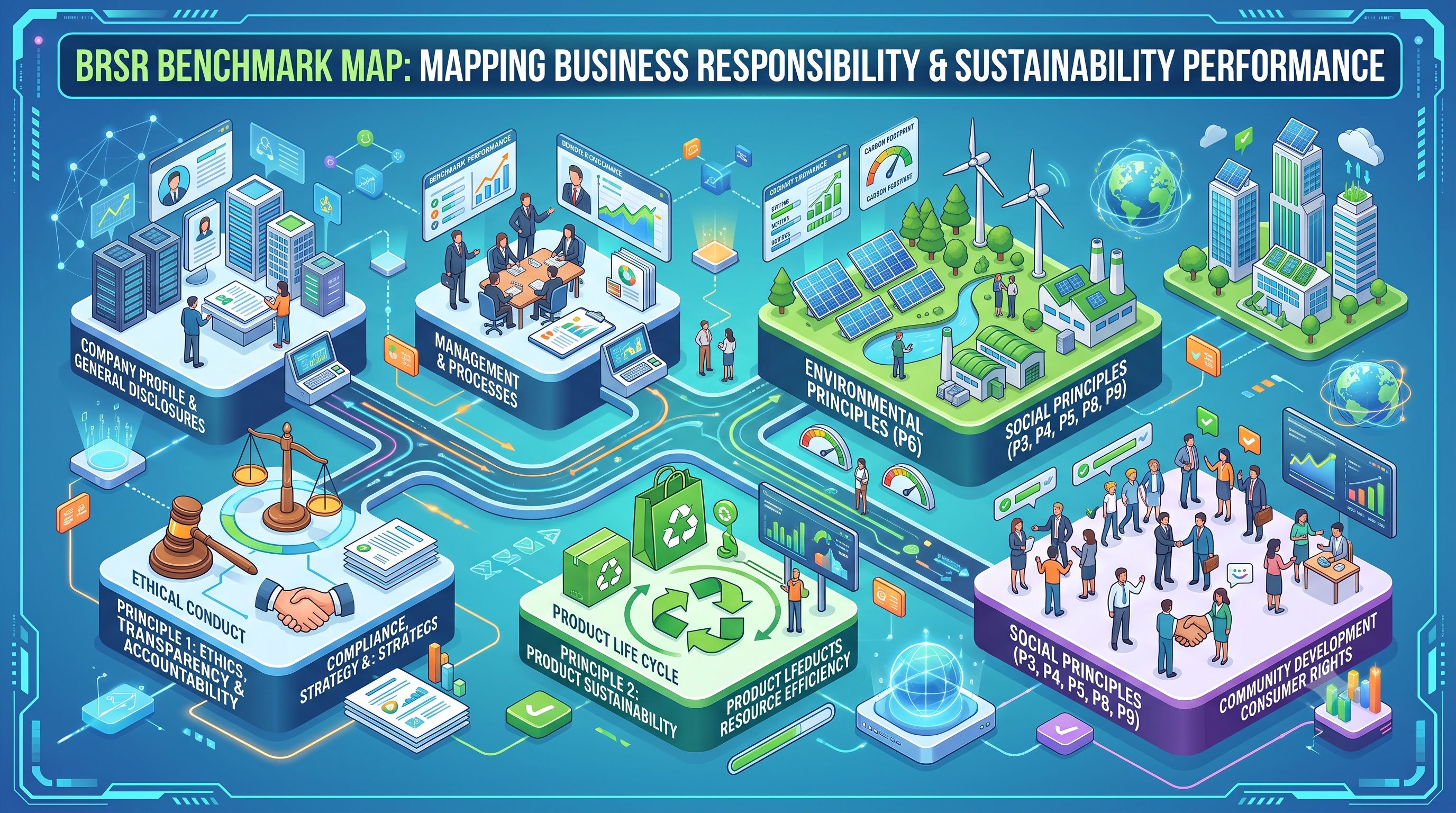
The 9 principles of the NGRBC (National Guidelines on Responsible Business Conduct, issued by the Ministry of Corporate Affairs in 2019) are the organizing spine of BRSR — every one of its ~140 questions is grouped under one of these 9 principles. Once you understand the 9 principles in plain language, the whole structure of BRSR Section C stops feeling like a random list of questions.
Who this is for
Anyone who's opened a BRSR form, seen "Principle 4" or "Principle 7" as a section header, and wondered what that actually means in practice.
Plain explanation
The NGRBC principles were written as broad, official-sounding statements — legally precise, but not exactly plain English. Here's what each one is really asking a business to do:
| # | Official principle (short) | What it actually means |
|---|---|---|
| 1 | Conduct business with integrity, ethics, transparency, and accountability | Run an honest company: no bribery, clear governance, don't hide things from regulators or shareholders. |
| 2 | Provide goods and services that are sustainable and safe | Make products that don't harm customers or the environment, across their whole lifecycle. |
| 3 | Respect and promote employee well-being, including in the value chain | Treat your workers well — fair wages, safety, no forced or child labor — and care about conditions at your suppliers too. |
| 4 | Respect the interests of and be responsive to all stakeholders | Listen to everyone affected by your business — employees, customers, communities, investors — not just shareholders. |
| 5 | Respect and promote human rights | Don't violate anyone's basic rights, and actively work to uphold them across your operations. |
| 6 | Respect and protect the environment | Reduce pollution, emissions, and resource use — and where possible, actively restore environmental damage. |
| 7 | Engage in public and regulatory policy responsibly and transparently | If you lobby or engage with government, do it openly — no backroom influence. |
| 8 | Promote inclusive growth and equitable development | Make sure your business benefits the wider community, not just your own bottom line. |
| 9 | Engage with and provide value to consumers responsibly | Be honest in marketing, protect customer data, handle complaints fairly. |
India specifics
BRSR's Section C — the largest part of the report — is organized principle by principle. Each principle has its own set of Essential Indicators (mandatory) and often Leadership Indicators (voluntary). So when you're filling out BRSR, you're not answering 140 random questions — you're working through 9 themes, one at a time, each with its own mini-set of disclosures.
This structure isn't unique to India — it mirrors how the UN Guiding Principles on Business and Human Rights and the OECD Guidelines for Multinational Enterprises are organized, which is intentional: NGRBC was designed to align with global norms while giving Indian regulators an India-specific version to point to.
Worked example
A mid-sized logistics company filling out BRSR for the first time might expect a wall of unrelated questions. Instead, they find:
- Under Principle 3 (employee well-being), questions about driver working hours and safety training.
- Under Principle 6 (environment), questions about fleet fuel consumption and emissions.
- Under Principle 9 (consumer responsibility), questions about how customer complaints about delivery damage are handled.
Once the company's sustainability lead realizes each section maps to a specific, recognizable theme, gathering the data becomes a matter of asking the right internal team (HR for Principle 3, operations for Principle 6, customer service for Principle 9) rather than guessing where to start.
Checklist
- Read through all 9 principles once, using the plain-English column above, before opening the actual BRSR form.
- Match each principle to the internal team that actually holds the relevant data (HR, operations, legal, customer service).
- Don't treat Section C as 140 flat questions — work through it one principle at a time.
- Note that Principles 3 and 6 tend to have the most Essential Indicators and the most number-heavy questions — budget extra time for these.
What to do next
Once the 9 principles make sense, the natural next step is understanding how they fit into the full BRSR filing.
Current as of: 22 July 2026. The 9 NGRBC principles themselves have been stable since the 2019 guidelines; verify against the current SEBI BRSR format for exactly which indicators sit under each principle, since indicator counts have shifted with amendments.
Sources: