ESG Basics
What Is ESG? A Plain-English Guide for Indian Companies
ESG stands for Environmental, Social, and Governance. Here's what it actually means for an Indian company, in plain language, with no jargon.
TL;DR
ESG stands for Environmental, Social, and Governance — three areas that measure how a company's operations affect the planet, its people, and how honestly it's run. In India, ESG isn't just a global buzzword: if you're a large listed company, you must report it every year in a filing called BRSR (Business Responsibility and Sustainability Report). If you supply one of those companies, your customer will likely ask you for ESG data too — even though you don't have to file anything yourself.
Who this is for
Anyone at an Indian company who has heard the term "ESG," been asked for ESG data by a customer or investor, and wants a straight answer to "what actually is this?"
Plain explanation
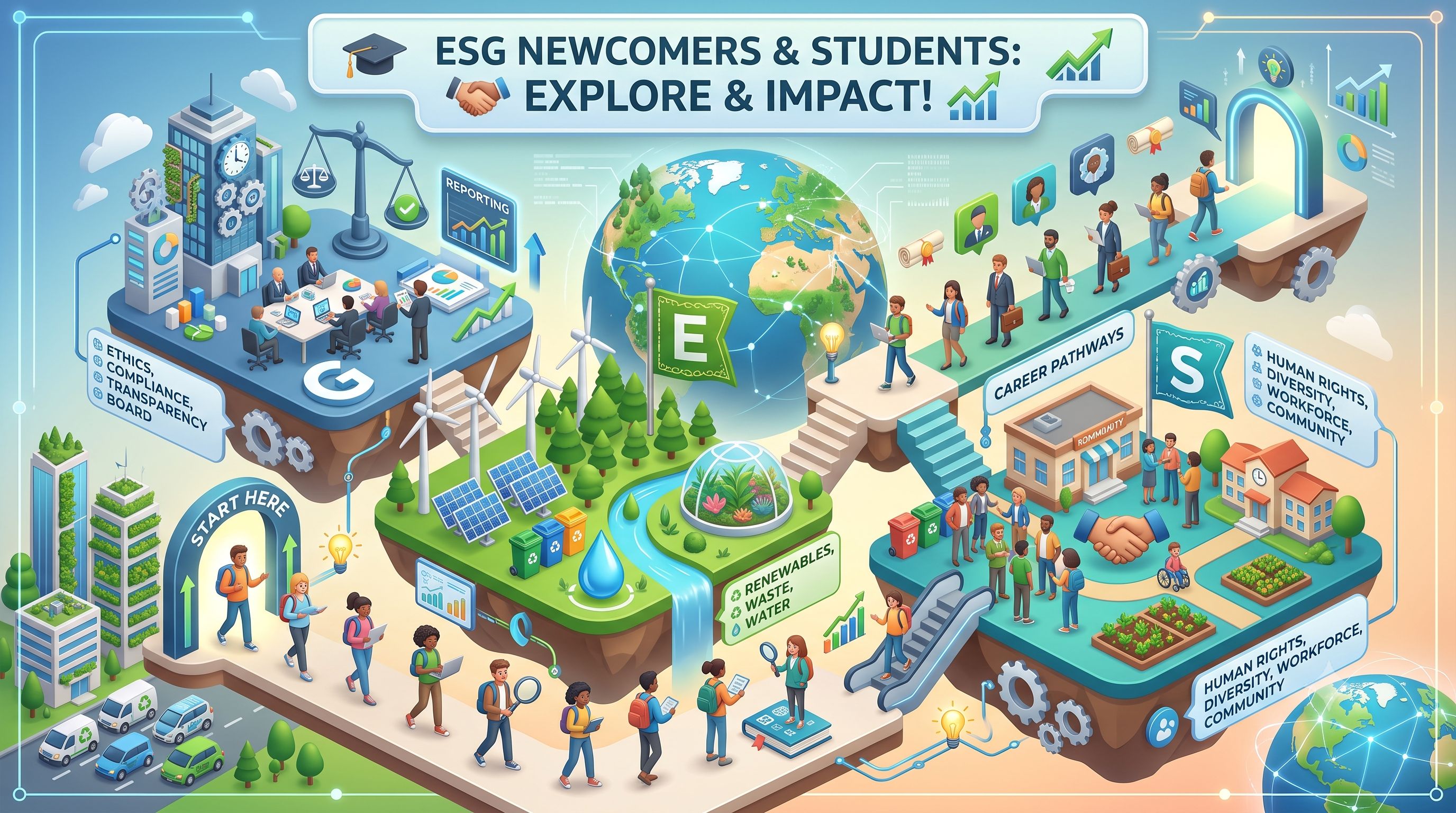
ESG is a way of scoring a company on things beyond its profit and loss statement. It has three parts:
- Environmental (E) — How much pollution, waste, and greenhouse gas the company produces. How much energy and water it uses, and where that energy comes from.
- Social (S) — How the company treats its workers (wages, safety, diversity), its customers (product safety, data privacy), and the communities around its operations.
- Governance (G) — How the company is run: board structure, executive pay, anti-corruption policies, and whether shareholders are treated fairly.
Investors, banks, and large customers use ESG information to decide who to fund, lend to, or buy from. A company with poor ESG practices is increasingly seen as a riskier company to do business with — not just a less virtuous one.
ESG is not the same as CSR. Corporate Social Responsibility (CSR) — a term Indian companies already know well because it's a Companies Act requirement — is about spending a slice of profit on social good. ESG is broader: it's about how the entire business operates, measured with data, and reported to investors and regulators, not just a spending line item. See our full ESG vs. CSR breakdown if you want the detailed comparison.
India specifics
India has turned ESG from a "nice to have" into a regulatory requirement, mainly through one filing:
- BRSR (Business Responsibility and Sustainability Report) is mandated by SEBI (India's securities regulator) for the top 1,000 listed companies by market capitalisation, and has been mandatory since FY 2022–23. It's filed as part of the annual report, in XBRL format.
- BRSR is organized around the 9 principles of the NGRBC (National Guidelines on Responsible Business Conduct, issued by the Ministry of Corporate Affairs in 2019) — covering everything from ethical business conduct to respecting human rights to engaging responsibly with the value chain.
- A tighter subset called BRSR Core (about 49 KPIs) must additionally be verified by an independent third party, on a glide path that widens each year — starting with the top 150 companies in FY 2023–24 and reaching the top 1,000 by FY 2026–27.
- If you're not a top-1,000 listed company, you don't have to file BRSR yourself. But if you supply one, don't be surprised when they send you a questionnaire asking for your emissions, safety record, or worker wage data — they need it to complete their own value-chain disclosures. That's usually the moment ESG stops being abstract for a smaller company.
Worked example
Meenal runs a packaging supplier in Pune with ₹18 crore in annual revenue. She's not a listed company, so BRSR has never applied to her directly. Then her biggest customer — a listed FMCG company that must file BRSR — emails her a "Supplier ESG Questionnaire" asking for:
- How much electricity her factory used last year, and how much came from renewable sources.
- How many workplace safety incidents occurred.
- Whether she has a written anti-bribery policy.
Meenal isn't filing BRSR. But her customer needs this data to fill in their own value-chain disclosures under BRSR. If Meenal can't answer quickly and credibly, she risks looking like a riskier supplier to keep — this is the value-chain effect pulling ESG down to companies that were never directly regulated.
Checklist
- Confirm whether your company is directly in scope for BRSR (top 1,000 listed by market cap).
- If you're not directly in scope, check whether any of your major customers are — they may ask you for ESG data anyway.
- Start tracking the basics now, even informally: electricity use and source, water use, workplace safety incidents, and any written policies you already have (anti-bribery, code of conduct).
- Don't confuse your existing CSR spending with ESG reporting — they're related but not the same thing, and a questionnaire asking for ESG data wants operational data, not a CSR budget line.
What to do next
If you're unsure whether BRSR applies to you directly, the fastest way to find out is to check your scope.
Current as of: 22 July 2026. BRSR thresholds and the BRSR Core assurance glide path are set by SEBI circulars and are reviewed here whenever SEBI issues an update — treat any date more than 12 months old as due for a recheck.
Sources: